vac·cine (vāk-sēn', vāk'sēn') n.
a. A preparation of a weakened or killed pathogen, such as a bacterium or virus, or of a portion of the pathogen's structure that upon administration stimulates antibody production or cellular immunity against the pathogen but is incapable of causing severe infection.
Vaccines are medical prevention tools. Generally speaking, a vaccine introduces a very weak version of the disease, or antigen, to the body. When the body recognizes the antigen as a foreigner, it fights off the disease. Because your body is designed to essentially "remember" germs, the vaccination procedure prevents you from getting infected with a more critical occurrence of the same disease should it enter your body (Citation 2). Vaccines offer protection against diseases caused by both bacteria and viruses (Citation 1).
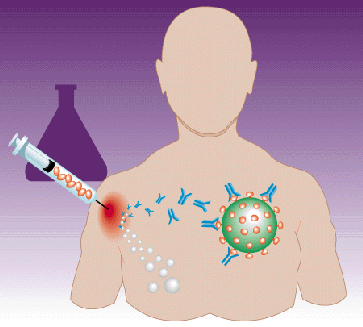
The following quote explains the general function of the vaccine, as visualized in the picture to the right: "The vaccine is made from an antigen [the orange dots] isolated or produced from the disease-causing microorganism [the green sphere]. The vaccine is injected into the blood stream. The B cells in the blood stream respond to the antigen by producing antibodies [the blue objects]. The antibodies bind to the antigen to "neutralize" or inactivate it. In addition, memory cells [the white spheres] are produced and remain ready to mount a quick protective immune response against subsequent infection with the same disease causing agent"(Citation 3).
|  |
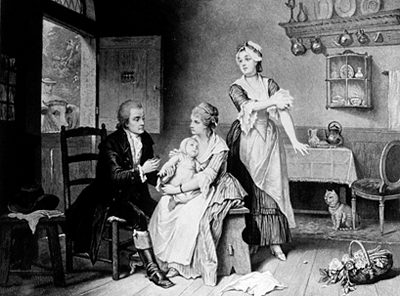
In the 18th century, an English physician by the name of Edward Jenner noticed that a surprising number of dairy farmers caught a mild measle-like cow disease called vaccinia, commonly known as cowpox. These same milk maids seem strangely immune to a similar, but more lethal human virus called smallpox. On a hunch, Jenner extracted the cowpox virus from infected girls and injected them into his own infant son. More daringly, he then injected the boy with potentially fatal smallpox. Ultimately, Jenner's cure worked! Although the cowpox made the young boy ill, it helped his body develop resistance to the disease, and looked enough like smallpox that his body battled that as well. Thus the term "vaccine" originates from the scientific name for cowpox, vaccinia. Below, Jenner inoculates his son with cowpox, who, after recovering, is then inoculated with smallpox but later remains healthy (Citation 4).
Vaccine Timeline
Jenner had created the first safe vaccine; however, he did not fully understand how this vaccine worked. That job was left to scientists, armed with microscopes and a few other tools, who took up Jenner's legacy and revolutionized the vaccine. Below is a "history of vaccines which have made great strides in reducing and eliminating vaccine-preventable diseases in the United States' and worldwide" (Citation 5).
18th century
1798 - Smallpox
19th century
1885 - Rabies
1897 - Plague
20th century
1917 - Cholera
, Typhoid vaccine (parenteral)
1923 - Diphtheria
1926 - Pertussis (whooping cough)
1927 - Tuberculosis (BCG)
1927 - Tetanus
1935 - Yellow Fever
1945 - The first influenza vaccines (flu) began being used
1955 - Inactivated polio vaccine licensed (IPV)
1955 - Tetanus and diphtheria toxoids adsorbed (adult use, Td)
1959 - World Health Assembly passes initial resolution calling for global smallpox eradication
1961 - Monovalent oral polio vaccine licensed
1963 - Trivalent oral polio vaccine licensed (OPV); the first measles vaccine licensed
1964 - Advisory Committee on Immunization Practices (ACIP), first meeting
1966 - U.S. Measles eradication goal enunciated
1967 - Mumps vaccine licensed
1969 - Rubella vaccine licensed: 57,600 rubella cases reported this year
1970 - Anthrax vaccine manufactured by the Michigan Department of Public Health
1971 - Routine smallpox vaccination ceases in the United States
1971 - Measles, Mumps, Rubella vaccine licensed (MMR)
1976 - Swine Flu (largest public vaccination program to date)
1977 - Last indigenous case of smallpox (Somalia)
1978 - Fluzone, the current flu vaccine made by Aventis Pasteur, was licensed
1979 - Last case of polio, caused by wild virus, acquired in the United States
1980 - Smallpox declared eradicated from the world
1981 - Meningococcal polysaccharide vaccine, groups A, C, Y, W135 combined (Menomune)
1982 - Hepatitis B vaccine becomes available
1983 - Pneumococcal vaccine, 23 valent
1988 - Worldwide Polio Eradication Initiative launched
1990 - Haemophilus influenzae type B (Hib) polysaccharide conjugate vaccine licensed for
infants, Typhoid vaccine (oral)
1991 - Hepatitis B vaccine recommended for all infants
1993 - Japanese encephalitis vaccine
1994 - Polio elimination certified in the Americas
1995 - Varicella vaccine licensed, Hepatitis A vaccine licensed
1996 - Acellular pertussis vaccine (DTaP) licensed for use in young infants
1998 - First rotavirus vaccine licensed
1999 - Lyme disease vaccine approved by the FDA, efforts begun to remove thimerosal, a
mercury based additive, from vaccines
21st century
2003 - First live attentuated influenza vaccine licensed (FluMist)
2006 - Human papillomavirus
2008 - Cervical cancer (HPV) (Citation 5)
What else does the future hold?
Here is a video recapping the history of the vaccine and introducing our next topic, methods of creating vaccines.
|
