Revolutionary Vaccines
Antifungal vaccines: In November 2000, scientists at the University of Wisconsin at Madison announced that they had created a live vaccine that protects against a fungal infection in mice. This vaccine was created using recombinant DNA technology. Why is it so much harder to create a vaccine against a fungus? "It may look simple to us, but compared with viruses and bacteria, a fungus is almost as complicated as the federal tax code" (Citation 6). The most widely used bacteria, E. coli, has about 4.6 million base pairs. HIV has less than ten thousand. The fungus used in this study has a genome of about 25 million base pairs. The larger the genome of the disease-causing microorganism, the harder it is to protect against.
Vaccines for cancer: Over half of the biotech vaccines currently under development are focusing on cancer. Researchers are developing vaccines targeting leukemia and cancers of the breast, pancreas, colon, brain, ovaries, and practically all other malignancies. Professor Alan Kingsman of Oxford Biomedica, a biopharmaceuticals company based in Oxford, England, explained, "What the cancer vaccine seeks to do is get the body's immune system to destroy tumor cells, to see those tumor cells, recognize them as dangerous and destroy them in much the same way as it destroys viruses and bacteria when we get an infection. Then the antibodies and cells of the immune system cruise around the body looking for that protein, recognize it as dangerous, and blow those cells away" (Citation 12).
 | One cancer vaccine already on the market is GARDASIL, produced by the biotechnology company Merck. GARDASIL is a subunit vaccine (citation book) that helps to protect against four different types of human papillomavirus: two of which cause over 70% of all cervical cancer cases, and the other two cause 90% of all genital wart cases. GARDASIL is recommended for girls and young women ages 9 to 26 (Citation 13). |
Recombinant vaccines are also under development to combat genital herpes, malaria, West Nile virus, HIV, allergies, and many other conditions (Citation 12). What new vaccines will be discovered in the future?
Production Methods
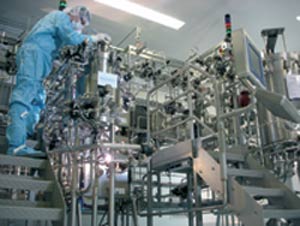
Most vaccines are produced in chicken eggs (see Methods). However, some people are allergic to eggs, and therefore are unable to receive potentially life-saving vaccines. One alternative method of vaccine production uses mammalian cell cultures instead of eggs. Enormous samples of these cells are grown up in 1,000 liter fermenters (stainless steel tanks). Next, a strain of the virus is also placed into the tank and is taken in by the cells. Over the course of several days, the virus begins to multiply in the cells, and eventually, the cells die off and release their copies of the viruses into the surrounding solution. The virus solution is then separated from the cell solution using chromatography (a chemical process that separates a mixture of materials into individual parts). Through purification and inactivation, the viral solution is transformed into a vaccine (Citation 11).
 |
|
Another method of vaccine production is to use plants. This technology is being developed by a company called iBioPharma, Inc., which is attempting to produce vaccines using plant-based technology purchased from by the Fraunhofer Center for Molecular Biotechnology (a nonprofit research group). Both iBioPharma and Fraunhofer are located in Newark, New Jersey. Once antigens are extracted from viruses, they are introduced into a molecular vehicle called a launch vector, which carry the antigen's genetic code. Then these launch vectors are introduced into bacteria, where they multiply rapidly. Next plants are dipped into a solution containing the bacteria, which enter the plants. Inside, the genetic material replicates rapidly and produces many copies of the target protein. After about a week, the plants are harvested and ground up to extract the protein. The protein can then be further purified into the final vaccine product (Citation 14).
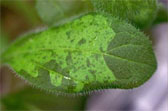 "Plants containing a target protein are | 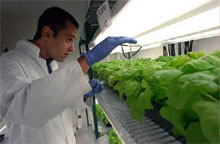 "Hassane Elhassani, a lab technician at |
Delivery Methods
Here's some good news for all the needlephobes out there! Vaccine delivery methods are changing. One example of this is FluMist, developed by the company MedImmune based in Gaithersburg, Maryland. FluMist does not require any needles - it is sprayed directly into the nostrils, and has an excellent success rate of over 90 percent (Citation 12). |  |
Another new method of vaccine delivery is the DNA vaccine, where DNA itself could be directly soaked into the skin. "Scientists at Stanford University have found that a simple solution of DNA and water applied to the skin of mice can transmit hepatitis B vaccine, stimulating an immune response just as strong as the traditional injection with a needle. The DNA vaccine was apparently absorbed through the hair follicles" (Citation 12). Lead researcher Dr. Paul Khavari told the New York Times, "In principle, the DNA solution could be put on a Band-Aid, or in a spray, or even in shampoo...DNA is so stable that you can walk around with it in your pocket for months at room temperature...The lack of need for refrigeration or special medical personnel makes it very attractive, especially in developing countries" (Citation 12).
Methods: Previous Page | Next Page: Issues and Impacts |
