How does one go about creating a vaccine? Obviously, a live, virulent microorganism cannot be used as a vaccine because though it would stimulate the production of antibodies, it would also cause the disease it should prevent. Therefore, to create an effective vaccine, one must isolate or create a microorganism (or part of one) that is unable to cause the full blown disease, but still retains the antigens to induce the immune response of the host. The following is a list of different types of vaccines which are created using different methods:
Inactivated vaccines are made by killing the virulent microorganism using formalin (an aqueous solution of formaldehyde.) The plus side to this method is that there is no possible way an inactivated vaccine could ever cause its disease once injected. However, this type of vaccine does not induce a very strong response from the immune system. Examples of inactivated vaccines include the typhoid vaccine and the Salk poliomyelitis vaccine.
Acellular vaccines use only the antigenic parts of the disease-causing microorganism (only parts that stimulate the production of antibodies, not anything that could actually infect one with the disease). Examples of antigenic parts include the protein capsule, the flagella, and parts of the protein cell wall. Acellular vaccines, like inactivated vaccines, do not induce a very strong immune response and thus often require a booster shot every few years to insure their continued effectiveness. The Haemophilus Influenzae B (HIB) vaccine (Citation 6) and the pertussis (whooping cough) vaccine are examples of acellular vaccines (Citation 7).
Attenuated vaccines are created by weakening a live microorganism through aging or altering its growth conditions. Vaccines made through this process are often the most successful vaccines, likely because they actually multiply in the body, thereby creating a large immune response. However, these live vaccines also carry the greatest risk of infection because they could mutate back to its pathogenic form at any time. Attenuated vaccines often deliver lifelong immunity, eliminating the need for additional booster shots. Vaccines against measles, mumps, and rubella (MMR) are examples of attenuated vaccines.
Toxoid vaccines are made from toxins (often treated with aluminum or absorbed onto aluminum salts to decrease their harmful effects). These vaccines usually induce low immune responses, and therefore are sometimes given with an adjuvant (an agent which increases the immune response). For example, the diphtheria and tetanus vaccines (both toxoid vaccines) are often combined with the pertussis vaccine (an adjuvant) and administered together as the DPT immunization. When multiple vaccines are given together like this, it is called a conjugated vaccine (Citation 6).
Subunit or recombinant vaccines are created using biotechnology and genetic engineering techniques. They contain purified antigens (Citation 8). The picture below depicts a simplified view of how a subunit vaccine is created. "This usually involves isolating one or more genes from a disease-causing agent with known antigenic properties and splicing those genes into plasmids (which are closed rings of self replicating DNA.) The rings are then delivered into small groups of cells, often by injection into muscle cells or by propulsion into the skin via a so-called gene gun. The plasmid is taken up by the host’s cells, transcribed and expressed. The body now produces the foreign antigen" (Citation 9).
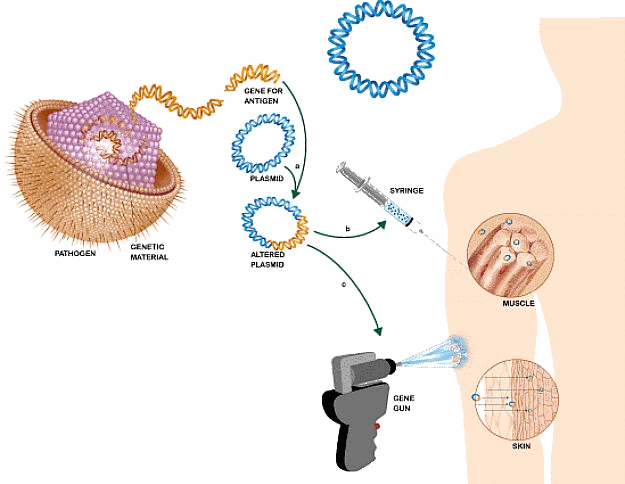
The actual process of creating a subunit vaccine is a little bit more complicated. "To create a subunit vaccine, researchers isolate the gene or genes which code for appropriate subunits from the genome of the infectious agent. This genetic material is placed into bacteria or yeast host cells which then produce large quantities of subunit molecules by transcribing and translating the inserted foreign DNA. It is important to note that these subunit molecules are encoded by genetic material from the infectious agent, not from the host cell's genetic material. These "foreign" molecules can be isolated, purified, and used as a vaccine." The Hepatitis B vaccine is an example of a subunit vaccine (Citation 6).
The following image explains in detail how a recombinant vaccine is being created against the West Nile Virus using the virus' RNA. This vaccine, as of 2005, was undergoing clinical trials (Citation 10).
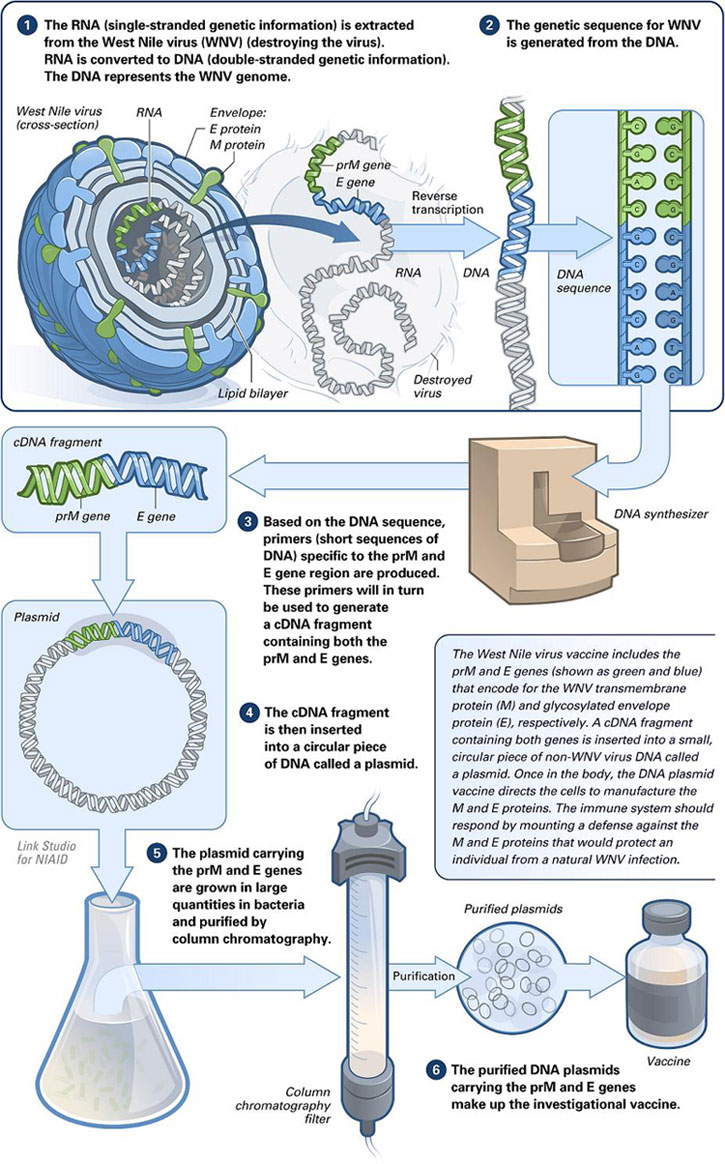
Vaccine Production
Now that a vaccine has been created in a laboratory, how does one go about mass producing it for the public? The traditional method of commercial vaccine production uses fertilized chicken eggs. The most common example of this is the seasonal influenza vaccine.
Eleven days after the egg is fertilized, a strain of the influenza virus (grown separately) is injected into the eggs and accumulates in the fluid surrounding the embryo. The embryo is then infected so the virus can multiply. After a few days of incubation, machines open the eggs and harvest the virus, which is then carefully purified and chemically inactivated to form the vaccine. This entire process takes about six months, and must be repeated every year (Citation 11). | 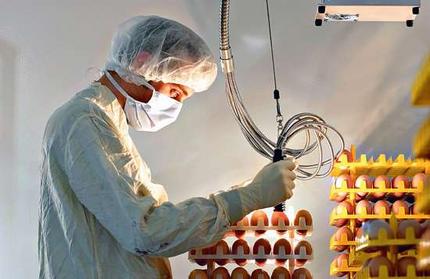 |
Overview: Previous Page | Next Page: Innovations |
